The Beginner's Guide to Using AI as a Parenting Assistant
New to AI parenting tools? No technical background needed. By the end of this guide, you'll know exactly what an AI parenting assistant is, five practical ways to use it today, and how to write prompts that get you genuinely useful responses.

It's 11pm. Your toddler won't sleep, your patience is running thin, and Google is giving you ten contradictory answers. Sound familiar? What if there was a calmer, smarter way to get help, one that didn't judge you, didn't charge a consultation fee, and was available at any hour of the night?
That's exactly what AI can be for modern parents. This guide is written for beginners - no technical background needed. By the end of it, you'll understand what AI parenting assistance actually means, five practical ways to use it today, and how to write prompts that get you genuinely useful responses.
What Does "AI Parenting Assistant" Actually Mean?
Let's strip away the jargon. AI — Artificial Intelligence is software that understands your questions in plain language and responds in a thoughtful, relevant way. Tools like ChatGPT and Google Gemini are the most common examples. They've processed millions of books, articles, and research papers. You simply type a question or describe a situation, and they respond.
An AI parenting assistant is simply one of these tools used specifically for parenting challenges. Think of it as a knowledgeable friend who has read every parenting book ever written, never gets tired, never judges your choices, and is available at 3am when you need them most.
Important to Know
AI is a thinking partner and idea generator, not a replacement for your instincts, your paediatrician, or the love you have for your child. It is a tool, and like any tool, it works best when used thoughtfully.
Why Are Parents Turning to AI for Help?
Modern parenting comes with a paradox: we have more information than ever, yet parents feel more confused and overwhelmed than any previous generation. One article says controlled crying builds independence; the next says it causes lasting emotional damage. One expert promotes screen-free evenings; another builds learning apps for toddlers.
AI cuts through the noise. Here's why parents — especially in India — are making the shift:
- Information overload from parenting blogs, WhatsApp groups, and well-meaning relatives giving conflicting advice
- Limited access to parenting coaches or child psychologists outside Tier 1 cities
- The need for patient, non-judgmental guidance without unsolicited opinions
- 24/7 availability — parenting emergencies don't follow office hours
- Personalised responses based on your child's specific age, temperament, and context
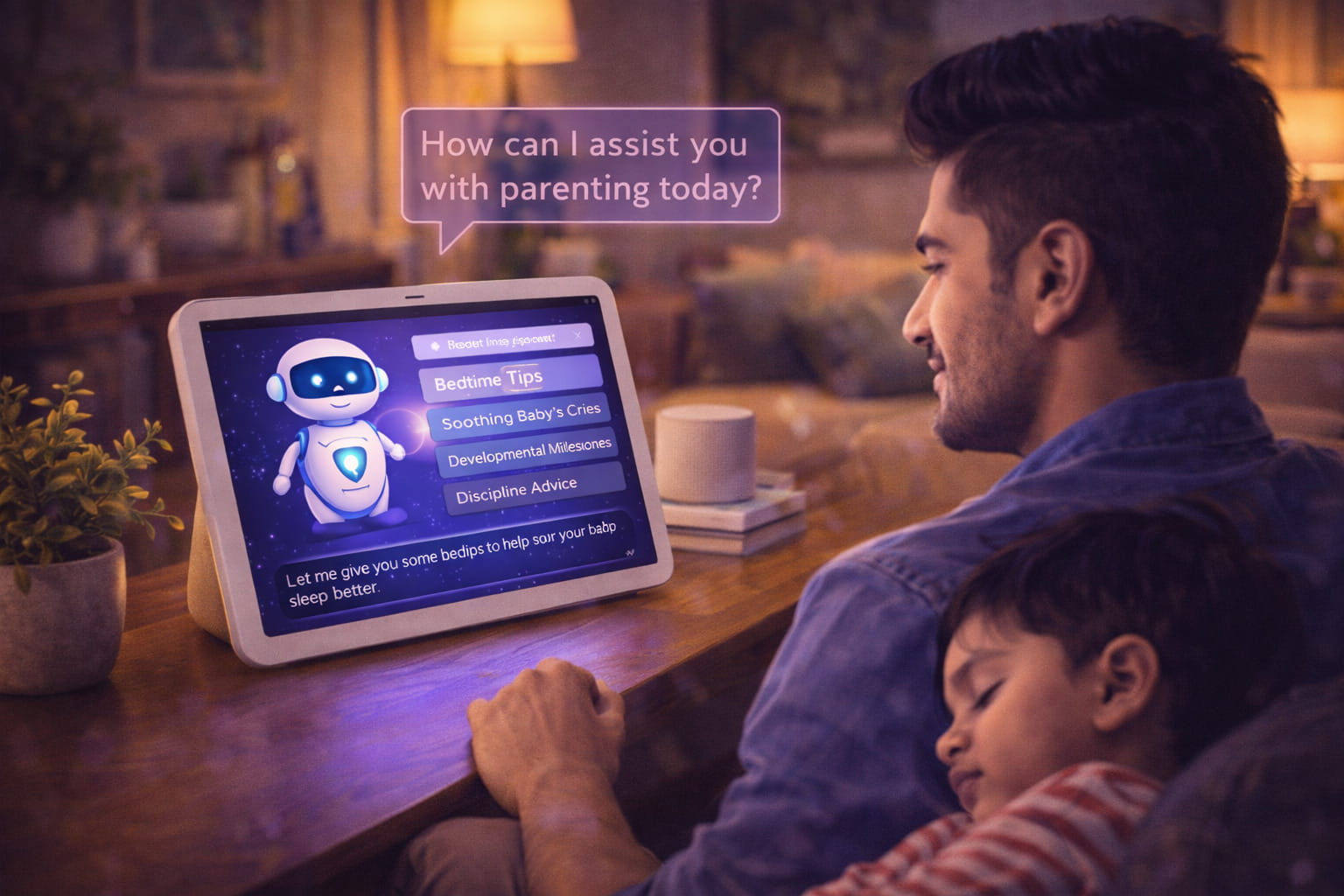
5 Ways AI Can Help You as a Parent (Right Now)
You don't need to overhaul how you parent. Start with just one of these five use cases this week. But first, a note on how to get good results from AI.
💡 The Prompt Formula
The quality of your prompt determines the quality of your answer. A vague question like "my child won't eat" gets a vague, generic response. Use this simple formula for much better results:
[Context about you/your child] + [Specific situation] + [What kind of help you need] + [Format or tone]
The five examples below all follow this structure. If you'd rather skip the trial and error entirely, CogniParent's Calm Parenthood ebook includes 45 ready-built, field-tested prompts for the 0–6 month stage — more on that at the end.
1. Answering Your Parenting Questions Instantly
Forget spending 40 minutes reading contradictory blog posts. Describe your exact situation to an AI and get a calm, specific response you can act on. The more context you give, the more tailored the answer.
Example Prompt
"I'm a parent of a 2-year-old boy who refuses to eat vegetables. He's happy eating fruit and daal. Give me 5 creative, realistic ways to introduce vegetables that work for picky toddlers in an Indian household."
2. Creating Personalised Bedtime Stories
Generic storybooks are fine. But a story where your child is the hero, one that features their favourite character and gently addresses something they're anxious about? That's something else entirely. AI can generate a brand new one every night.
Example Prompt
"Write a 5-minute bedtime story for a 4-year-old named Arjun who loves dinosaurs and is scared of the dark. Make it gentle and calming, and end with him feeling brave and ready to sleep."
3. Building Daily Routines and Schedules
Consistent routines are one of the most evidence-backed tools for child development. AI can help you build one that fits your family's real lifestyle — not a one-size-fits-all template written for a parent in a different country.
Example Prompt
"Help me create a practical morning routine for a 6-year-old before school. We have 45 minutes. Include breakfast, getting dressed, and a short calm activity. Make it realistic for a working parent in an Indian household."
4. Handling Difficult Conversations With Your Child
"Why did Nani die?" "Where do babies come from?" "Why are some kids mean to me?" Some questions stop parents dead in their tracks. AI can help you find the right words before the conversation happens.
Example Prompt
"How do I explain death to a 5-year-old in a gentle, age-appropriate way? I want to be honest but not frightening. Give me a short script I can adapt for tonight."
5. Managing Your Own Parenting Stress
The most underrated use of AI for parents: taking care of yourself. Overwhelm, guilt, and exhaustion are real. AI won't replace therapy, but it can offer grounding techniques when you're on the edge and need something in the next three minutes.
Example Prompt
"I'm feeling completely overwhelmed as a parent right now. Give me 5 quick, realistic calming techniques I can use in the next 3 minutes without leaving the room."

How to Get Started — Step by Step
You don't need to be tech-savvy. If you can send a WhatsApp message, you can use AI. Here's how to begin:
Step 1 — Choose Your Tool
Start with ChatGPT (chat.openai.com) or Google Gemini (gemini.google.com) — both have free versions. No account needed to begin on Gemini.
Step 2 — Use the Formula
Always include context about your child, the specific situation, and what format you want. This is the difference between generic advice and something actionable.
Step 3 — Start With One Challenge
Don't try to use AI for everything at once. Pick the one parenting challenge causing you the most stress this week and try AI just for that.
Step 4 — Cross-Check Medical Advice
AI is excellent for ideas, scripts, and routines. For anything medical or developmental, always follow up with your paediatrician.
What AI Cannot Do — Be Honest With Yourself
AI is genuinely useful. But it has real limits, and being aware of them makes you a smarter user:
- It cannot replace your emotional presence. Your warmth, attunement, and instincts are irreplaceable. No AI can parent your child for you.
- It cannot diagnose medical or developmental conditions. If you're concerned about your child's health or development - always see a doctor.
- Its responses can be generic without good prompting. A vague question gets a vague answer. The more specific you are, the more useful the response.
- It is not a substitute for professional mental health support. For serious emotional or psychological challenges, yours or your child's, please seek qualified help.
⚠️ Always Remember
AI guidance should not replace medical or professional advice when serious issues arise. It works best as a thinking partner, not a final authority.
A Note for Indian Parents
Parenting in India carries a unique set of joys and pressures. Joint families, bilingual households, academic competition starting as early as nursery school, and the deep influence of grandparents create a parenting context that most Western advice simply doesn't address.
Here's the good news: AI is context-aware. When you describe your specific situation, "I'm a working mother in Pune with a joint family and my in-laws have different views on screen time", you get advice that fits your life, not advice written for a parent in California.
For parents in Tier 2 cities who don't have easy access to parenting workshops or child psychologists, AI can be a meaningful equaliser. Always include your location context in prompts, "I'm an Indian parent…" or "in a joint family setting…" — it dramatically improves the relevance of what you receive.
Your First Week With AI — A Simple Challenge
The best way to understand AI parenting tools is to simply try them:
- Day 1: Ask AI one parenting question you've been wondering about but haven't found a satisfying answer to.
- Day 3: Use AI to plan a fun, age-appropriate activity for your child this weekend — something new you haven't tried before.
- Day 7: Generate a personalised bedtime story for your child. Read it together. Notice what happens.
New Parent? Skip the Trial and Error.
If your child is between 0 and 6 months, the learning curve is steepest — and the stakes feel highest. CogniParent's Calm Parenthood ebook contains 45 real-case, structured prompts covering the most common infant challenges: fever, breathing, feeding, colic, falls, skin concerns, and vaccinations. Each prompt is already written in the formula described above — context, situation, format, so you just copy, paste, and get your answer.
Get Calm Parenthood for ₹499You're Already a Good Parent — AI Just Makes the Hard Days Easier
Here's the truth: you don't need AI to be a good parent. You already are one. The very fact that you're reading a guide like this, trying to do better, learn more, stress less, is proof of that.
AI won't make you a perfect parent. Nothing will. But on the days when you're exhausted, overwhelmed, or simply stuck for the right words — it can offer a creative idea, a calm response, or a moment of breathing room when you need it most.
That's what CogniParent is built for. Not to replace you, but to quietly support you, whenever you need it.
Frequently Asked Questions
What is an AI parenting assistant?
An AI parenting assistant is a tool powered by artificial intelligence — such as ChatGPT or Google Gemini, that helps parents get instant, personalised answers to parenting questions, generate bedtime stories, build routines, handle difficult conversations, and manage stress. It acts as a knowledgeable, always-available companion, not a substitute for professional medical advice or your own parental instincts.
How can AI help parents with daily challenges?
AI can help parents by answering specific questions instantly, generating personalised bedtime stories, building age-appropriate routines and schedules, suggesting scripts for difficult conversations with children, and offering stress management techniques when parents feel overwhelmed.
Is it safe to use AI for parenting advice?
AI parenting tools are safe for general guidance, creative ideas, and everyday support. They should never replace professional medical or developmental advice. For any health or developmental concerns, always consult a qualified paediatrician or child specialist.
What are the best AI tools for new parents?
For beginners, ChatGPT and Google Gemini are excellent free starting points. CogniParent's Calm Parenthood ebook offers 45 ready-to-use, structured prompts designed specifically for Indian parents with infants aged 0–6 months, making AI accessible without any technical knowledge required.
Related Articles

AI Parenting: The Powerful 2026 Guide Every Modern Parent Needs
Discover the true meaning of AI parenting and how it's transforming family life for parents everywhere...
Read More →
How to Use ChatGPT for Parenting Questions
A practical guide to getting helpful, calm answers from AI when you need them most at 2am...
Read More →
When to Call the Pediatrician: A Parent's Guide
Know the red flags and when it's time to seek medical attention for your baby immediately...
Read More →